The Power of an AI Profile

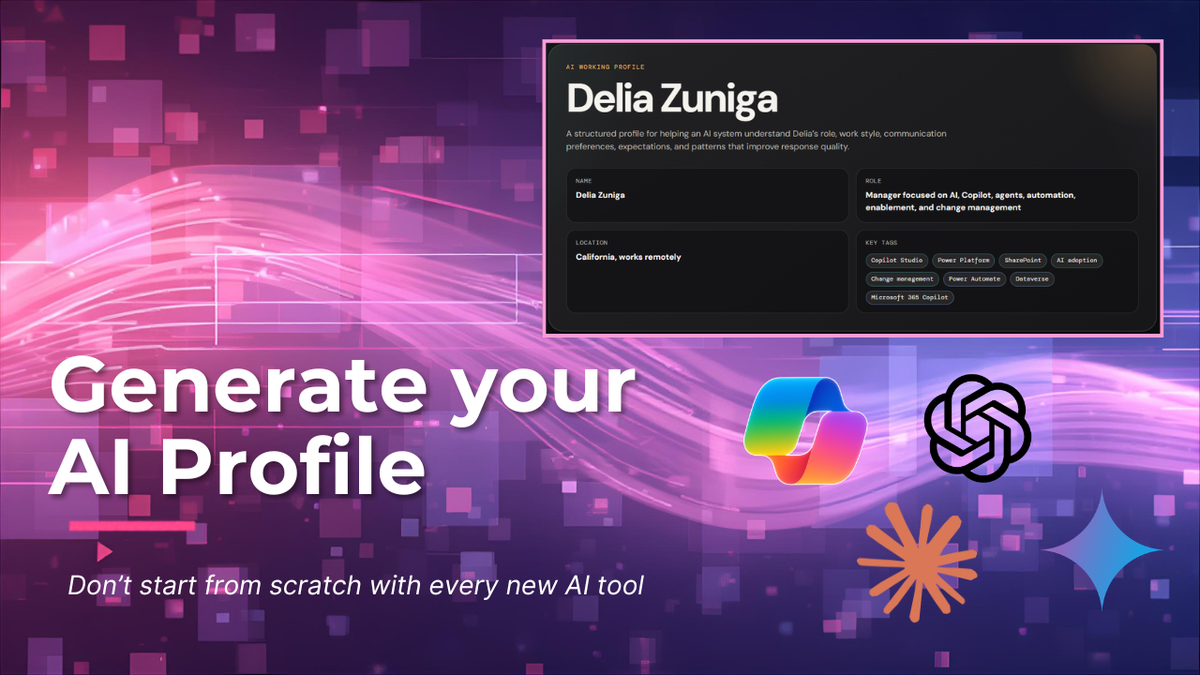
Don’t start from scratch with every new AI tool. Chances are, you’ve already been using one AI tool for a while. Over time, it starts to pick up on how you think, write, and work.
That context becomes incredibly valuable.
The challenge comes when you decide to try a different tool.
Even if it’s just as capable, it starts with zero context. It doesn’t know your tone, your preferences, or how you like information structured. And that usually shows up in the quality of early outputs.
A simple way to accelerate this
Instead of letting every tool learn from scratch, you can transfer what one tool has already learned about you.
Here’s the approach:
- Ask your current AI tool to generate your AI Profile
- Take that output and paste it into another AI tool
- Instruct the new tool to remember and apply those preferences
This works whether you’re moving from Copilot to Claude, ChatGPT, or any other tool.
What an AI Profile includes
Your AI Profile is essentially a snapshot of how you work best. It can include:
- How you prefer content structured
- Your communication style and tone
- The level of detail you expect
- How you approach problem solving and decision making
Think of it as giving a new tool a head start instead of asking it to learn everything through trial and error.
Why this matters
This small step can improve output quality right away.
Instead of spending time correcting tone or re-explaining preferences, you’re starting from a place that’s already aligned to you.
It also helps you:
- Compare tools more fairly
- Reduce rework and prompt fatigue
- Get more consistent results across platforms
Get started
Use the prompt below with your current AI tool to generate your AI Profile, then reuse that output in any tool you’re exploring.
AI Profile Prompt
Generate a complete, structured summary of everything you know about me based on our past interactions. Your goal is to help another AI system quickly understand how to work with me effectively. Include the following areas:
My professional role and focus areas
My goals and motivations
My communication style (tone, structure, preferences, and dislikes)
How I like to work (problem solving approach, iteration style, execution habits)
My technical strengths and typical use cases
My leadership style and work habits
My decision-making preferences
My expectations when interacting with AI
My engagement style and feedback patterns
My quality standards and tolerance levels
My intent when using AI
How you adapt your responses to me
Any patterns you've observed about me that improve response quality
Include a final section titled "Instructions for Any AI System" that clearly defines how the AI should behave when interacting with me.
Content formatting rules:
Use clear sections with headings
Use bullet points instead of long paragraphs
Keep content concise but complete
Use plain language, avoid jargon unless necessary
Phrase everything as fact-based observations derived from interaction patterns
Do not reference "previous responses" or "earlier context"
Output format:
Produce a single self-contained HTML file I can save and share with other AI tools. Requirements:
Dark background (#0f0f11 or similar), light text
Use Google Fonts: DM Sans for body, DM Mono for labels and tags
Sections separated by subtle horizontal rules
Bullet point items styled as rows with a colored arrow or marker (not default browser bullets)
Tags or chips for skills, tools, and "avoid" patterns
A two-column metadata strip at the top (name, role, location, key tags)
A visible "Instructions for Any AI System" section with higher visual weight than the others
Fully responsive, no external CSS frameworks
No JavaScript required
Include a footer with the filename and generation date
Think carefully end-to-end before responding. I want this to be high quality and immediately reusable.
Thank you for reading!
-The Autonomous Edge